As many as 60 percent of the Kenyan population now has access to electricity according to official data. But in neighbouring Tanzania, the penetration rate is less than half of that and sparsely populated rural communities are especially neglected.
понедельник, 17 апреля 2017 г.

Arkansas Executions Incite Legal Battle over Process (Audio)
(Bloomberg) -- Robert Dunham, executive director of the Death Penalty information center and Austin Sarat, a professor or Jurisprudence and political science at Amherst College, discuss a judge's decision to block Arkansas' attempts to carry out a series of executions in a matter of days. They speak with June Grasso and Michael Best on Bloomberg Radio's "Bloomberg Law."
Isaiah Thomas Mourns Death Of Little Sister; Celebrities Show Their Support
The Boston Celtics point guard held his head high!
Early Saturday morning, Isaiah Thomas' 22-year-old sister Chyna died in a one-car collision in their home state of Washington. Her car reportedly veered off of Interstate 5 into a jersey barrier and pole.

The Boston Celtics point guard held is head high as he made the difficult, yet courageous, decision to play in Game 1 of the NBA playoffs on Easter Sunday.
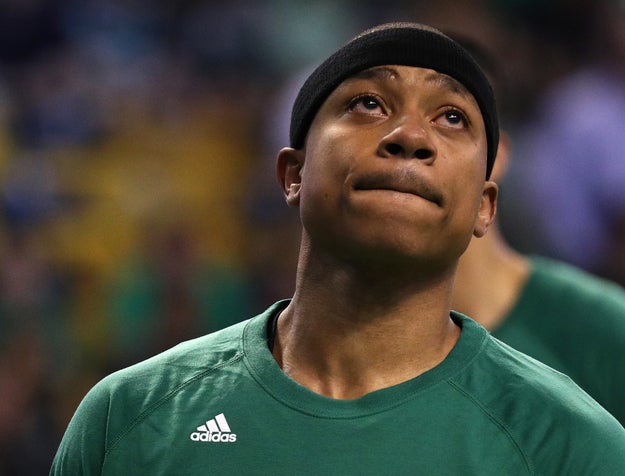
Maddie Meyer / Getty Images
Overwhelmed with emotion, Isaiah tried his best to cope with loss of his little sister while preparing for the big game.
суббота, 15 апреля 2017 г.
Toronto Sports Media April Open Thread
By TSM We are taking care of some housekeeping at the corporate HQ, so this bud’s for you! Enjoy an amazing Toronto Sports day Jays Raptors Leafs TFC Jonah
пятница, 14 апреля 2017 г.
Letting go

— John Berger, and our faces, my heart, brief as photos, p 55
“This is the Hour of Lead –
Remembered, if outlived,
As Freezing persons, recollect the Snow –
First – Chill – then Stupor – then the letting go –”
— Emily Dickinson, After a great pain, a formal feeling comes.
Robert MacFarlane’s Landmarks is a “counter-desecration phrasebook”: a vocabulary for valuing what we have just as we are about to lose it, just as we are losing it, just as we have already lost it.
It is as if the living world, of shivelight and suthering tides, of desire lines and whale’s ways, of glaise and drindle, sumping sea-lochs and high headlands, could be saved through re-description. As if it wasn’t already too late.
The last fourteen months have, one after another, broken global temperature records. Floods and droughts begin to assume Biblical proportions. Thousands of species disappear, forever, each year. Even on the mildest prognostications, they will disappear faster and faster.
With a 1.5 degree temperature increase above pre-industrial levels, 20-30 per cent of species risk extinction. With a 3.5 degree increase, the range is 40-70 per cent. We are already at 1.3 degrees, and 4 degrees is the current projected temperature by 2050, even if the Paris Agreement survives.
As the rate of acceleration increases, so does the probability of chaos. Scientists use the metaphor of ‘uncharted territory’ to describe this, since all we know for sure is what we are losing. What will never, ever be seen again.
Walking, in this way, becomes an urgent voyage, a pilgrimage, a visit to a dying patient. A stolen glimpse of what might have been won, had the earth ever been a common treasury.
But as Christopher Bollas points out, what we find in the environment is our own unconscious life — not in its narrative, nor in its scenery, but in keywords, objects. The more abstract, nonsensical and formless the terrain, the more we can project into it, and the more evocative it seems. Nothing is more evocative than what theologians, following Psalm 22, call ‘the night season’.
What you find in the burnt edge of a cool morning, the summer shimmer of riparian wetlands, clouds the size of cities soaking in a blue pool, or even in the literary outdoors, the cold mountains of Han-Shan, the freezing Yukon of Call of the Wild — is unconscious meaning.
Worlds of independence, adventure, possibility, decivilization, worlds teeming with potential, closer to birth than death. Oceanic immersion, the feeling of being held, protection. Phobias and anxieties. Screen memories. These private meanings always open out into public meaning. What Renee Lertzman calls “environmental melancholia” begins with lost worlds. Melancholia is a kind of freeze. Mourning is movement, and if you can’t mourn, you gather frost.
One of the biggest obstacles to mourning is that we can’t face our ambivalence: the extent to which we hated the lost object of our love. The ambivalence is complicated. On the one hand, it seems, no matter how much they meant to us, we’re always in some part of us glad to be shot of them. On the other hand, we also hate them for no longer being there. And there are the unconscionable pleasures and benefits that accrue from their absence.
We can hardly help being ambivalent about what we call ‘nature’ and its nemesis, fossil capital. The former means desperate, hard, labouring lives and early deaths. The latter, to the extent that it is coextensive with industrialisation, means comfort, central heating, celerity.
So what is the greenhouse defrosting of arctic sea ice, the bleached death of a coral reef, and the disappearance of thousands of species every year compared to air travel, moon voyages, genetic science laboratories, and the internet. What is the silence of the remote croft, or the murmur of the forest, compared to rising life expectations and falling infant mortality?
The other side of this ambivalence, the nocturnal side, is the knowledge — because this is no mystery, and anyone who wants to know already knows — that we are preparing a mass wake for the human species. It is a planned obsolescence. There are some hubristic billionaires who, by investing in survivalist Xanadus, fancy they will survive the collapse of the food chain and the destruction of habitable territory. Few have the luxury of that conviction. So, put another way, the questions above become: what is species death compared to another fifty years of life for capitalism?
It is useless to berate the insufficiently woke. We are all sleep-walking, and all half-dreaming, even if we dream of being awake. We are all hastening toward the last syllable of recorded time. And the point of melancholic subjectivity is that we are already berating ourselves. Our experience of powerlessness in the face of loss, and isolation before gigantic, tectonic forces, has already become our mantra of self-hate. Adding reproach in the name of the future would only accentuate our resentment of future generations, and our desire to punish them.
But if mourning is movement, it is also work. The work of mourning is not the same thing as the sharp, icicle stab of grief one might feel, while walking, when you suddenly realise that some day and soon, nothing that looks like this world will exist. It is the painful, laborious task of revisiting each memory, each thought, each impression, of what has been lost and, like Poe’s raven, meeting it with the judgement, “nevermore”. Mourning is not an uplifting process. It is a kind of despair, because it means giving up. First chill. Then stupor. Then the letting go.
Only when we can separate the object that has been lost, from what has been lost in it, do we recover. In other words, we give up without giving up. We fully and relentlessly recognise the loss, but we hold onto the qualities we saw in the lost object, because we think we can find a way to revive them in a new passion, a new attachment. We despair, but we do not submit.
“Despair without fear, without resignation, without a sense of defeat,” Berger called it, speaking of the Palestinians and their Nakba. “Undefeated despair.”
четверг, 13 апреля 2017 г.
Against nature
We are being asked to believe. That is the first thing to take note of. We are exhorted to put aside doubt in the existence of human nature, and believe. The very fact that the argument is put in these terms is surely no accident. If 'human nature' were a self-evident reality that we could all agree on, there would be no need to believe. I don't "believe" in water, or air, or the colour blue; I can only believe in things that I can't know. Belief, in a sense, belongs to the register of certainty, but not knowledge.
Now the article goes on to claim that 'human nature' is something that we can know, but the conception that it offers is comparable to that other chestnut of contemporary discourse, 'British values'. Humans need to eat. Well, what's so special about that? Lots of animals need to eat. Humans need warmth. So do cockroaches. Humans are vulnerable to disease and organic decay. So is vegetation. Humans need to drink. So does Nigel Farage. That isn't 'human nature', that's just 'nature'.
The argument only really becomes interesting, and germane to the human, when it claims the existence of a human need, rooted in nature, for 'dignity' and 'autonomy'. But these are surely not needs in the sense that food and air are needs. They are the names for preferences, or desires, which are proper to linguistic creatures.
But once we are talking about language and desire, we are no longer strictly speaking talking about nature, because language and desire are historically and socially produced. Language marks the point at which the human animal makes a half-leap from nature to culture. In other words, as soon as you get to the characteristic that makes us properly human -- the fact that we are linguistic creatures -- you're already no longer in the domain of nature (indeed, you were never really in it).
And it is just as well to recognise this, because otherwise the argument becomes terribly tricky for socialists. Since the terms 'autonomy' and 'dignity' are glittering generalities which everyone is supposed to believe in (if only for themselves), having no intrinsic, uncontested, unhistorical, natural, given content, you have to engage in some logical gymnastics.
You can try to give these terms some content, at which point you risk bumping into all manner of phenomena which contradict them. For example, you might find that some people (maybe some Trump voters) will give up what you have defined as 'autonomy', in order to deprive others of it. Having done that, you can then try to question-beggingly define all apparently unavailing phenomena as a thwarted, deflected attempt at achieving these ends. It becomes even more complicated if you do try to relate the more unsavoury aspects of human behaviour to 'human nature'.
Suppose we abandon the distinction between need and desire, and concede that we do indeed have a need for 'autonomy' and 'dignity', howsoever defined, because of 'human nature'. Shouldn't we also make space for such needs as aggression, violence, domination, sadism, and omnipotence? On what ground do we insist that these are not needs while autonomy and dignity are? Eventually, if we were to proceed like this, we could end up with a concept of 'human nature' that covered every possible type of desire by redescribing it as a 'need', and every possibly type of action by redescribing it as an attempt to realise a 'need'. But then it would just be tautologous rather than informative. We would 'believe' in human nature, but to no avail.
A lot of the persuasive power of these types of argument derive from the idea that to doubt the existence of 'human nature' is to subscribe to a "blank slate" thesis. This is an idea shared by Steven Pinker and the author of this piece. Of course, even a "blank slate" is never really blank. It must have certain active qualities which enable/constrain inscription. But the real problem with a "blank slate" thesis, is that a slate is fairly limited in what it can be. It is there to be written on, or not.
As the biologist Steve Rose puts it, humans are 'radically indeterminate'. In part, this is because it is in the 'nature' of living systems to be like that, but language opens up a new kind of indeterminacy. To say that we are radically indeterminate does not entail that we have no organic constitution, but that this does not determine whether we are 'good' or 'bad', kind or selfish, nurturing or violent, sexist or egalitarian, or whether we prefer protection to autonomy, or domination to dignity, and so on. These things, the desires and behaviours which are characteristically human, are the contested product of history.
This brings us back to the major problem with speaking about 'human nature', which is that humans are distinctly unnatural creatures. Indeed, the very separation of nature and culture becomes problematic once humans enter the frame (meaning, it has always been problematic, since this conceptual cleavage is a human invention). As soon as human beings learned to make fire, they became co-constituted by technology (the body being nourished and reproduced by digesting cooked food). There is not a single human organic capacity that is not intricated with technology, culture and political power. Haraway's term "natureculture" is a more apt way to describe the material realities of human bodies and their relevance to politics.
'Human nature' is a contradiction in terms.
Now the article goes on to claim that 'human nature' is something that we can know, but the conception that it offers is comparable to that other chestnut of contemporary discourse, 'British values'. Humans need to eat. Well, what's so special about that? Lots of animals need to eat. Humans need warmth. So do cockroaches. Humans are vulnerable to disease and organic decay. So is vegetation. Humans need to drink. So does Nigel Farage. That isn't 'human nature', that's just 'nature'.
The argument only really becomes interesting, and germane to the human, when it claims the existence of a human need, rooted in nature, for 'dignity' and 'autonomy'. But these are surely not needs in the sense that food and air are needs. They are the names for preferences, or desires, which are proper to linguistic creatures.
But once we are talking about language and desire, we are no longer strictly speaking talking about nature, because language and desire are historically and socially produced. Language marks the point at which the human animal makes a half-leap from nature to culture. In other words, as soon as you get to the characteristic that makes us properly human -- the fact that we are linguistic creatures -- you're already no longer in the domain of nature (indeed, you were never really in it).
And it is just as well to recognise this, because otherwise the argument becomes terribly tricky for socialists. Since the terms 'autonomy' and 'dignity' are glittering generalities which everyone is supposed to believe in (if only for themselves), having no intrinsic, uncontested, unhistorical, natural, given content, you have to engage in some logical gymnastics.
You can try to give these terms some content, at which point you risk bumping into all manner of phenomena which contradict them. For example, you might find that some people (maybe some Trump voters) will give up what you have defined as 'autonomy', in order to deprive others of it. Having done that, you can then try to question-beggingly define all apparently unavailing phenomena as a thwarted, deflected attempt at achieving these ends. It becomes even more complicated if you do try to relate the more unsavoury aspects of human behaviour to 'human nature'.
Suppose we abandon the distinction between need and desire, and concede that we do indeed have a need for 'autonomy' and 'dignity', howsoever defined, because of 'human nature'. Shouldn't we also make space for such needs as aggression, violence, domination, sadism, and omnipotence? On what ground do we insist that these are not needs while autonomy and dignity are? Eventually, if we were to proceed like this, we could end up with a concept of 'human nature' that covered every possible type of desire by redescribing it as a 'need', and every possibly type of action by redescribing it as an attempt to realise a 'need'. But then it would just be tautologous rather than informative. We would 'believe' in human nature, but to no avail.
A lot of the persuasive power of these types of argument derive from the idea that to doubt the existence of 'human nature' is to subscribe to a "blank slate" thesis. This is an idea shared by Steven Pinker and the author of this piece. Of course, even a "blank slate" is never really blank. It must have certain active qualities which enable/constrain inscription. But the real problem with a "blank slate" thesis, is that a slate is fairly limited in what it can be. It is there to be written on, or not.
As the biologist Steve Rose puts it, humans are 'radically indeterminate'. In part, this is because it is in the 'nature' of living systems to be like that, but language opens up a new kind of indeterminacy. To say that we are radically indeterminate does not entail that we have no organic constitution, but that this does not determine whether we are 'good' or 'bad', kind or selfish, nurturing or violent, sexist or egalitarian, or whether we prefer protection to autonomy, or domination to dignity, and so on. These things, the desires and behaviours which are characteristically human, are the contested product of history.
This brings us back to the major problem with speaking about 'human nature', which is that humans are distinctly unnatural creatures. Indeed, the very separation of nature and culture becomes problematic once humans enter the frame (meaning, it has always been problematic, since this conceptual cleavage is a human invention). As soon as human beings learned to make fire, they became co-constituted by technology (the body being nourished and reproduced by digesting cooked food). There is not a single human organic capacity that is not intricated with technology, culture and political power. Haraway's term "natureculture" is a more apt way to describe the material realities of human bodies and their relevance to politics.
'Human nature' is a contradiction in terms.
`Charging Bull' Lawyer Defends `Fearless Girl' Suit (Audio)
(Bloomberg) -- Steve Hyman, a partner at McClaughlin and Stern, discusses the lawsuit he is bringing against the "fearless girl" statue on behalf of the artist who sculpted "charging bull," which stands directly next to the girl. He speaks with June Grasso on Bloomberg Radio's "Bloomberg Law."
Подписаться на:
Сообщения (Atom)